World’s First Context OS for Agents
Have been building something we believe is a fundamental shift in how AI systems operate at scale.
Not a graph database. Not a vector database. Not a document store.
KyraDB: The world’s first context operating system for agents.
The problem with today’s AI infrastructure is that every agent, every model, every workflow operates on isolated, disconnected context. There’s no shared memory. No causal awareness. No audit trail for why an agent made a decision. No coordination layer when two agents act on conflicting information simultaneously.
That breaks down fast in enterprise environments where dozens of agents are running concurrently, making decisions that affect each other.
KyraDB solves this with three primitives that don’t exist anywhere else:
1. The Immutable Context Log
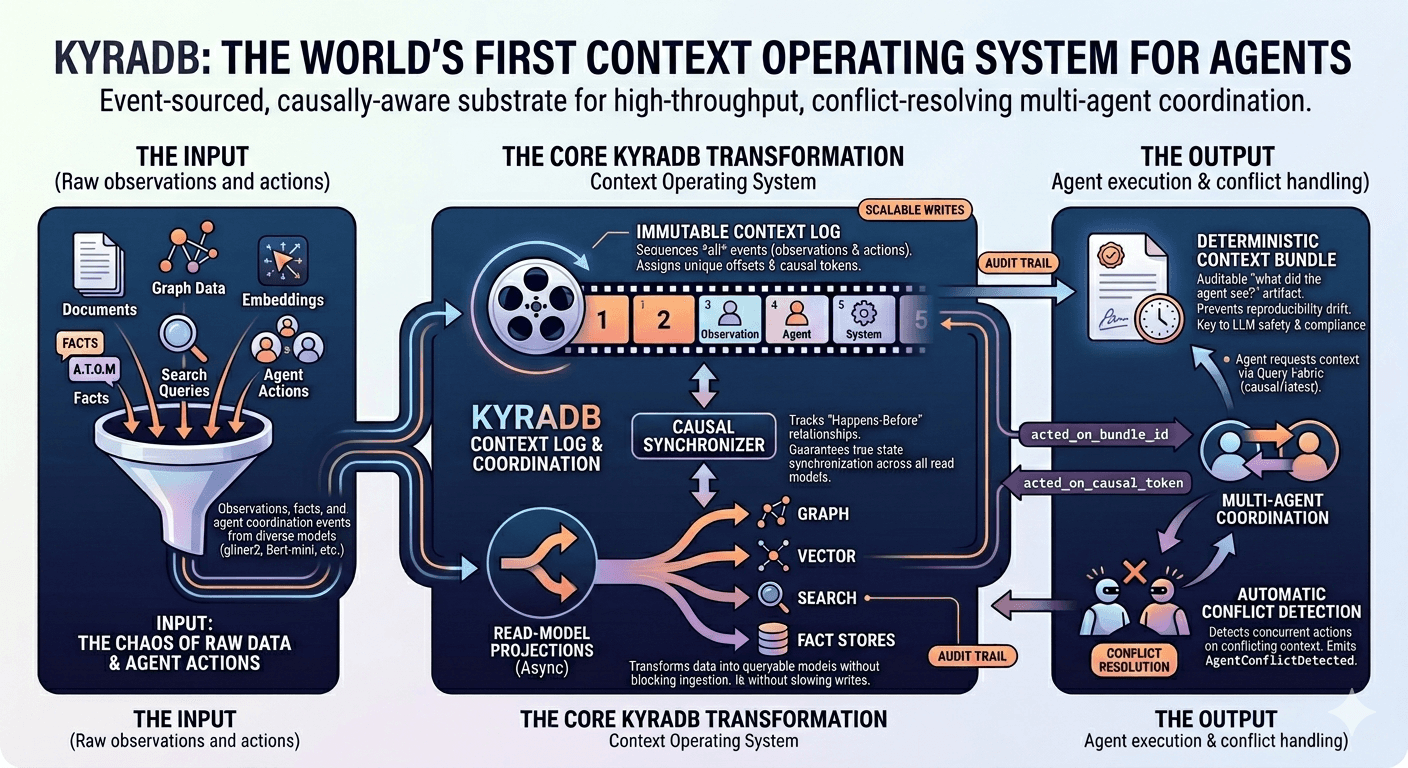
Every observation, fact, document, signal, and agent action is appended to a single causally-ordered log. This is the source of truth. Graph, vector, search, and fact stores are all derived read models. The write path does one thing: append and return a causal token. Nothing blocks ingestion.
2. The Deterministic Context Bundle
When an agent reads context to make a decision, KyraDB assembles a ranked, pruned, token-budgeted bundle and stores it immutably. Forever. You can always answer “what exactly did this agent see, and why?” That’s not just good engineering. In regulated industries, that’s a compliance requirement.
3. Causal Conflict Detection
Every agent write-back carries the bundle ID and causal token it acted on. If two agents act concurrently on conflicting context, KyraDB detects it structurally and emits an AgentConflictDetected event rather than silently accepting divergent state. Conflict resolution becomes an observable, auditable event in the log.
The architecture inverts the standard database assumption. Instead of:
write to primary store -> fan out to indexesKyraDB does:
append to log -> async read model projections -> query fabric -> immutable context bundle -> agent acts -> write back with causal tokenEvery read model (graph, vector, search, ATOM facts, identity) is an async projection from the log. Each owns its own storage, offsets, and rebuild strategy. Adding a new read model never touches the write path.
This matters now because the agent era is not coming. It is here. And the infrastructure layer that lets agents share context, coordinate safely, and remain auditable does not exist yet.
That’s what we’re building.
More soon.